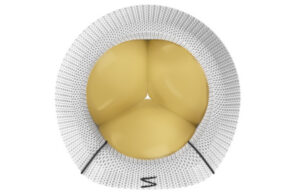
The first-of-its-kind Edwards Lifesciences Triformis Resilia doesn’t look all that different from the structural heart device developer’s other prosthetic valves, but a simple yet critical design change allows it to address an unmet patient need.
Edwards earned FDA approval for Triformis Resilia in May 2026. It’s the first surgical valve designed for the tricuspid position. Surgeons previously used mitral valves for tricuspid valve replacement because there were no surgical replacement tricuspid valves approved for use.
“Due to a relatively small market and challenges in conducting prospective clinical studies of dedicated surgical tricuspid valves, manufacturers have not innovated on these devices,” Edwards said in its FDA Summary of Safety and Effectiveness Data for Triformis Resilia.
The new valve “introduces a purpose-built surgical option for a long-underserved area of structural heart care and extends Edwards’ Resilia tissue technology to the tricuspid position,” the company said in a statement shared with Medical Design & Outsourcing.
A tricuspid-specific design
Like the other valves, Triformis Resilia is a low-profile stented prosthetic with three Resilia bovine pericardial tissue leaflets attached to a lightweight nitinol wireform.
But the Triformis valve has a new sewing ring design meant to match the native tricuspid anatomy for replacing native or prosthetic heart valves.
The Edwards Mitris implant has a “saddle-shaped” sewing cuff with an atrialized cuff design to reduce ventricular protrusion in mitral valves. But the new Triformis valve has a sewing ring with a flat profile that mimics the tricuspid annulus for optimal seating. The sewing ring’s flattened section along the septal region was designed to avoid antrioventricular (AV) node disruption.
MDO Min-Vasive Medtech: Download our free special report featuring interviews with minimally invasive device development experts and engineers at major OEMs like Edwards
The AV node is located near the septal leaflet of the tricuspid valve, connecting the electrical systems of the heart’s upper and lower chambers. AV node disruption (also known as AV block) can cause abnormal heart rhythms, chest pain, shortness of breath, dizziness and fatigue.
Edwards said its pre-clinical study of Triformis in the tricuspid position resulted in no significant conduction abnormalities, no evidence of structural or nonstructural dysfunction and demonstrated optimal seating.
Triformis’ structure and materials
The Triformis Resilia tricuspid valve comes in five sizes: 25 mm, 27 mm, 29 mm, 31 mm and 33 mm.
Edwards chose nitinol for the wireform because the nickel-titanium alloy’s superelastic characteristics allow the stent posts to fold 55° during implantation, avoiding suture looping. The wireform is covered in polyester fabric.
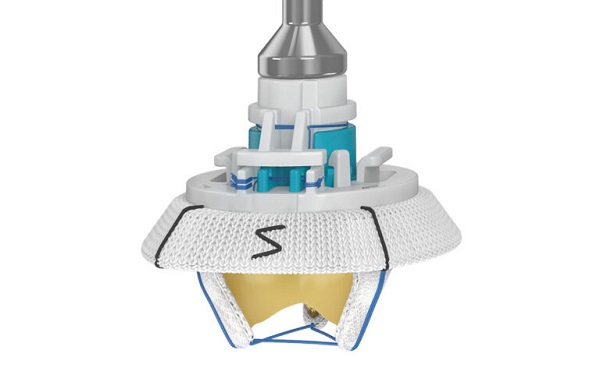
A cobalt-chromium alloy band and a polyester band that surround the base of the valve below the wireform provide structural support for the valve’s orifice.
Like other Edwards structural heart valves, the nitinol wireform and cobalt-chromium alloy band are visible on fluoroscopy to help the surgeon identify the valve’s inflow and outflow edges to determine a landing zone.
The tricuspid-specific Triformis sewing ring is made of compliant silicone-rubber and covered with a porous, seamless polytetrafluoroethylene (PTFE) cloth. It’s attached to the valve’s wireform frame and facilitates tissue ingrowth and encapsulation.
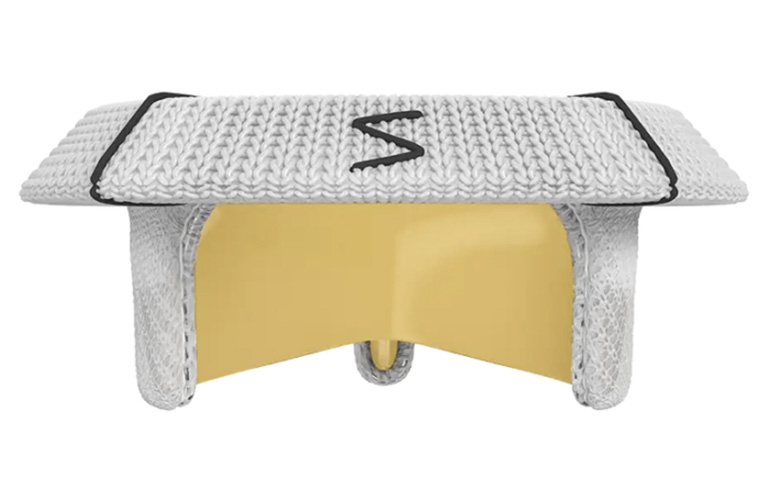
To aid orientation of the valve during implant, single black lines along the sewing ring mark the posteroseptal and anteroseptal commissures and an ’S’ marks the anterior septal segment.
Nitinol for cardiac implants: MDO’s Nitinol Knowledge webinar returns with a Medtronic distinguished engineer
Resilia tissue technology
The Triformis valve’s three Resilia bovine pericardial tissue leaflets in the valve are created with Edwards Integrity Preservation technology.
In FDA filings, Edwards says that technology “incorporates a stable-capping anti-calcification process that blocks residual aldehyde groups known to bind with calcium.”
The Edwards Integrity Preservation technology “also incorporates tissue preservation with glycerol, which replaces the traditional storage in liquid-based solutions such as glutaraldehyde with dry storage, which eliminates tissue exposure to the residual unbound aldehyde groups commonly found in glutaraldehyde storage solutions and the need for rinsing prior to implantation.”
Edwards says this novel technology has been shown to reduce calcification and pannus in pre-clinical studies and enhance valve durability and hemodynamic performance. And in this latest valve, Edwards said a pre-clinical study showed good hemodynamic performance and good leaflet mobility.
Edwards has said it plans to launch the Triformis Resilia valve in the second half of 2026.
source: medicaldesignandoutsourcing